Social media and AI in 2026: where to invest your time
Social media and AI: where to invest three hours to be found and cited by ChatGPT, Gemini, Perplexity and the other answer engines.
You have three hours this week for your social media. Not three hours a day: three hours, full stop. Where do you put them? TikTok, Facebook, Instagram, YouTube, Reddit or LinkedIn?
For a long time, the answer depended mostly on where your customers were. That still holds. But in 2026 one variable is added: generative AI tools are now part of the search journey, and they decide which social media platforms they quote.
Social media and AI: what artificial intelligence changed
ChatGPT, Gemini, Claude, Perplexity, Grok, Microsoft Copilot and Meta AI now field the questions people used to type into Google. Recommendations, comparisons, explanations, ideas for an outing or a supplier.
For a business, the question widens. It is no longer only about being visible in Google or in a feed: these systems also have to understand who you are, what you do, and in which context your content is relevant.
The difficulty is that engines do not look in the same places and do not present information the same way. A small business with little time has to avoid spreading itself thin and choose deliberately — which makes this a question of social media strategy, not of tooling.
The engines do not look in the same places
It is tempting to look for a simple rule: "post there and the AIs will cite you." Reality is more nuanced. Visible sources vary by engine, by question, by search mode, by language, by region and by product version.
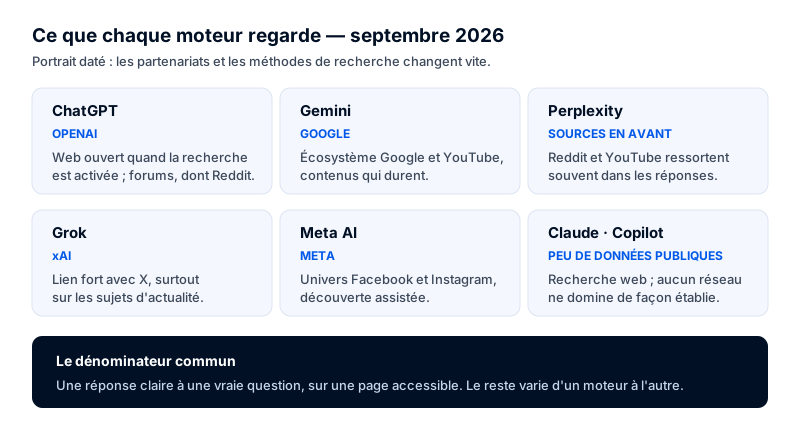
ChatGPT
When web search is on, ChatGPT can draw on a wide range of pages. Forums and communities such as Reddit show up when their discussions answer the exact question asked.
Gemini and Google's AI experiences
Google starts with an advantage: its search ecosystem and YouTube. That strengthens the case for content answering real searches and staying relevant over time.
Perplexity
Perplexity puts sources front and centre. In observed samples, Reddit and YouTube come up regularly among the social platforms cited. It would be a mistake to turn that into a permanent rule: the proportions move quickly.
Grok
Grok is tightly linked to the X ecosystem. On current-events topics, what gets published and discussed on X carries particular weight there.
Claude and Microsoft Copilot
Both can search the web, but little public data supports the claim that one social network systematically dominates their citations. A useful reminder to be careful before turning an observation into a strategy.
Meta AI
Meta AI sits inside the Facebook and Instagram universe. For a business already active there, social presence is no longer only about reaching followers: it feeds a discovery process that is increasingly AI-assisted.
A snapshot with a date on it
What works in September 2026 can change fast. Engines change their partnerships, their methods and their interfaces. A strategy built on this month's ranking ages badly; one built on usefulness does not.
Reddit and YouTube, for two different reasons
Step back from looking for an absolute winner, and two platforms keep coming up in discussions about visibility in AI engines.
Reddit: the written conversation
Reddit holds detailed discussions, comparisons, recommendations, lived experience and, above all, an enormous volume of questions followed by answers. For an engine trying to understand a very specific question, that is rich material.
YouTube: explanation and demonstration
YouTube lets you show a product, a place, a method, a problem and its solution. A good explainer keeps a far longer shelf life than an ephemeral post, and its spoken content is transcribed — therefore machine-readable.
The two are complementary: written conversation and human experience on one side, visual explanation on the other. Most small businesses can feed one of them without hiring anyone.
What about TikTok?
TikTok remains very important for discovery and for certain audiences. But it would be simplistic to claim that in September 2026 it is the number one network for citations across every engine.
Some studies have shown TikTok performing strongly, in a given context and with a given methodology. That is exactly what makes the subject slippery: the ranking shifts fast. Reddit and YouTube are signals worth watching, without abandoning the platforms where your customers actually are.
Content creation: where your three hours go
A small business has no content team, no videographer, no SEO specialist and no community manager. With three hours this week, the goal is not to be everywhere.
The first question should not be "how many posts can we produce?" but "which real customer question can we answer better than anyone else?"
Only then comes the choice of format and platform. A demonstration naturally becomes a video. A question calling for comparisons and experience suits a community discussion. A deeply rooted local business still gets a lot from Facebook or Instagram. A B2B company has good reasons to prioritize LinkedIn.
The goal is not to replace your social media marketing with a strategy aimed at robots. It is to produce content useful to humans, clear enough that engines understand it too.
A note on AI generated content, since the question always comes up: using AI tools to draft, reformulate or subtitle is perfectly reasonable. Publishing unreviewed output is not. Engines increasingly favour material with a verifiable source and a real point of view, and so do readers.
The decision table
This is not a universal ranking of social media: it is a way to decide based on the kind of content you can actually produce.
| Your situation | Likely priority | Your three hours go to… |
|---|---|---|
| You can explain or demonstrate visually | YouTube | Answering one precise question on video, with a clear title, description and script. |
| Your field generates many questions and experiences | Reddit and communities | Finding the relevant threads, understanding the questions, contributing where it fits. |
| You are a local business with an active community | Facebook and Instagram | Answering your customers' real questions and producing precise local content. |
| You are mainly B2B | Turning a frequent customer question into an expert post, case study or concrete explanation. | |
| Your field moves with the news | X and real-time platforms | Bringing context, facts or expertise to conversations already under way. |
| You are starting out and do not know what to post | Question research | Listening to Reddit, Quora, Google, YouTube and your own staff to build a bank of topics. |
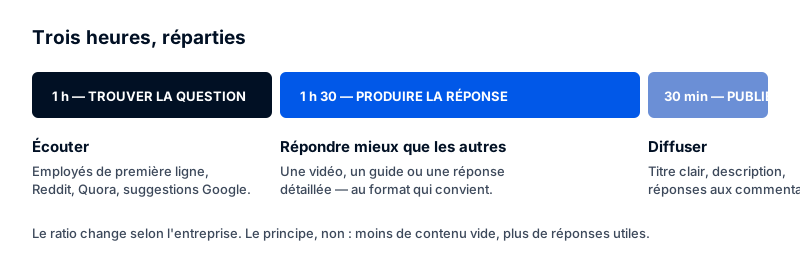
You can also divide the three hours simply: one hour to find and pick a real question, ninety minutes to produce a solid answer, thirty minutes to publish properly and reply to comments. The ratio varies by business; the principle does not.
Write and speak to be understood
One thing matters more with AI-assisted search: plain language.
On YouTube, do not assume the engine grasps the context because the picture shows your subject. When you speak, name things: the product, the activity, the place, the problem, the type of customer, the question you are answering.
Same logic in a written discussion: use the words your customers actually use. This is not a return to keyword stuffing. Repeating the same phrase ten times makes the text unpleasant and rarely more useful.
The point is to remove ambiguity. If your video explains where to paddleboard with kids in the Laurentians, say it in those words. If you are answering about shoes for men with very wide feet, use those words rather than "our product".
The best optimization is often a sentence a human understands immediately and a machine can interpret without guessing.
Not sure what to post? Listen to the questions
The problem is rarely producing content. It is knowing what to produce.
The topics are already around you. Before buying a sophisticated tool, ask the people answering the phone, the emails and the messages to write down the questions that keep coming back.
Your front-line staff hold valuable information: they know what customers do not understand, what worries them, what they compare and what they ask before buying. Those interactions beat any analytics tool.
Where to find more questions
- Reddit: your industry's threads, and above all the precise questions in the comments.
- Quora: the questions asked, and the angles that draw several answers.
- Facebook groups: in local sectors, the same questions come back endlessly.
- Google: autocomplete suggestions, related questions and related searches.
- YouTube: the comments under the popular videos in your field.
- AnswerThePublic: useful for discovering phrasings, even on its limited free tier.
- Your own customer service: emails, calls, chat, objections before purchase.
Narrower beats broader
A small business does not need to win the broadest topic. It can become the best answer to a much narrower question.
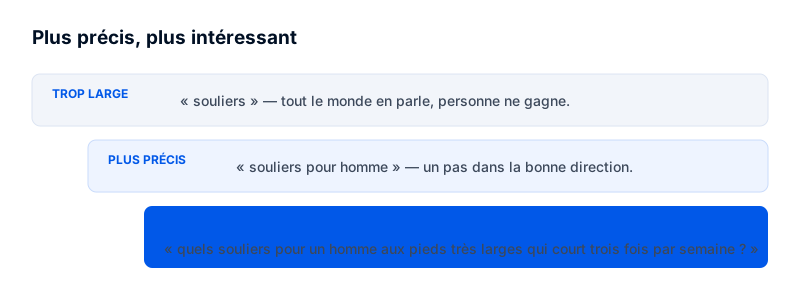
"Shoes" is enormous. "Men's shoes" is already narrower. But "which shoes for a man with very wide feet who runs three times a week" matches a concrete need — and an answer you can give better than anyone.
That is usually where the best opportunities are. A general question leads to an answer, which triggers a narrower question. That sub-question becomes your next video, your next guide, your next post.
If you do not know what to publish, do not start from a blank page. Start from the questions people already ask.
What it changes for user experience and social media performance
One thing is worth saying, because it is reassuring: everything that makes your content readable by an engine also makes it better for a person.
A title that states the question. An answer in the first sentences. Concrete words instead of agency vocabulary. A video whose subject is clear without sound. These are user experience rules before they are optimization rules.
The same holds in e-commerce: a product page answering the real questions — size, lead time, care, compatibility — serves the customer and the engine at once. Users arriving from an AI answer have already read a summary; they come looking for the detail the summary lacked. A page that supplies it converts better than one repeating generalities.
The same reasoning applies to your marketing as a whole. A business that honestly documents what it does — its lead times, its limits, its edge cases — builds material engines can cite and customers can verify. It is slow, and it lasts.
How to tell whether it is working
Measuring visibility in AI engines is harder than measuring a Google ranking, and that has to be accepted: no tool today gives a reliable, stable number. That does not mean flying blind.
The first reflex costs five minutes a month: ask ChatGPT, Gemini and Perplexity the three questions your customers actually ask, and see who gets cited. Write down the names. If your competitors are there and you are not, you at least know where you stand.
The second signal is indirect but telling: new enquiries that open with "I asked ChatGPT and it mentioned you." You still have to ask. Add the question to your contact form, the way businesses have always asked "how did you find us?"
The third is more familiar: traffic to your site and your videos. Engines that cite a source also send visitors to it, and those visitors arrive with sharper intent than average.
What to take away
The question looked simple: which social network should you favour to show up in AI answers?
You could answer TikTok, Reddit or YouTube depending on the latest study. The September 2026 reality is more interesting. Reddit and YouTube stand out as two platforms to watch — one for the richness of its written conversations, the other for the power of visual explanation. That does not mean abandoning Facebook, Instagram, LinkedIn, TikTok or X if that is where your customers are.
The real strategy has three moves: understand the questions people ask, choose the ones your business can answer excellently, and publish that answer in the right format on the right platform.
Social media will change. AI engines will too. The sources they favour today will not be the same in six months. But one thing will likely stay true: if your customers have a question and you build a genuinely useful, clear and accessible answer, you give yourself every chance.
So the next time you have three hours, do not start with "what do we post this week?" Start with "which question are we going to answer better than everyone else?" That small shift may be the most important content strategy of the AI era.